What Is a Video Sales Letter (VSL)?
A video sales letter (VSL) is a sales video that makes a complete pitch, from the opening hook to the offer and the call to action, usually on a landing page built around the video. It is the written sales letter turned into video: the same persuasive argument, delivered in a fixed order, so the viewer hears the case for the offer before they see the price.
VSLs sit at the center of direct-response video funnels. Vidalytics was founded in 2016 by Patrick Stiles, who started using VSLs in 2010 to grow Zen Life Supplements (our story), and video funnels hosted on Vidalytics have sold over $3.5 billion (Funnels & VSLs). This guide draws on that data and on customer tests published on this site.
A VSL at a glance
- Stands for
- Video sales letter
- Used to
- Sell a product, book a sales call or capture a lead, from cold or warm traffic
- Parts
- Hook, problem, mechanism, proof, offer, call to action
- Where it lives
- A landing page with the video and a button that appears at the offer
- What to measure
- Play rate, retention at the call to action, CTA clicks, conversions, revenue
How a video sales letter works
A VSL replaces the long text sales page with a presentation the viewer watches in order. In a typical VSL funnel it sits in the middle of four steps:
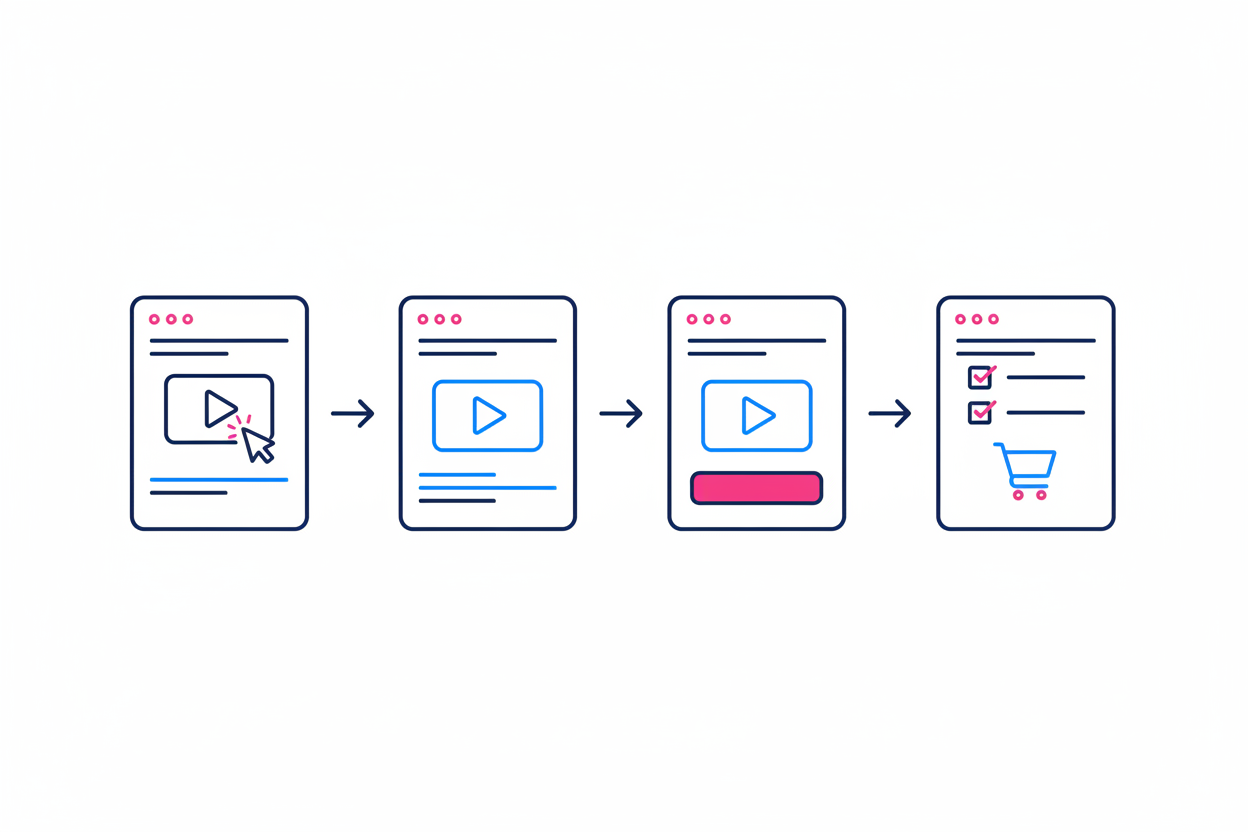
- Traffic. An ad, search result or email sends the visitor to the page.
- The VSL page. A headline and the video, with no navigation to leave through.
- The offer reveal. When the presenter introduces the offer, a buy button, application form or calendar appears under the video.
- The conversion. Checkout or a booked call, followed by upsells or onboarding.
Because the viewer cannot skim to the price, they take in the problem, the explanation and the proof before they judge the offer. That is the point of the format, and it is why the video player matters: anything that lets a viewer skip ahead, wander off to another video or miss the opening seconds breaks the argument.
VSL vs. webinar vs. video ad
| Format | Where it runs | Its job |
|---|---|---|
| Video ad | In a social feed, search or pre-roll | Stop the scroll and earn the click to the VSL page |
| VSL | On demand, on a landing page | Make the full pitch and close the sale or book the call |
| Webinar | Live or automated, behind a registration step | Teach, then pitch, to the people who register and show up |
The registration step is where webinars lose people. Our Next-Gen Video Funnel training illustrates it with 1,000 hypothetical ad clicks: 500 register, 250 show up, 100 reach the first call to action and 50 see the whole pitch. A VSL starts the pitch the moment the page loads.
The structure of a VSL
Most VSLs follow the same six-part arc, taken from direct-response copywriting. The timings below are the long-form layout from our VSL funnel guide. Shorter VSLs compress the same parts rather than dropping them.
| Part | Long-form timing | What it does |
|---|---|---|
| 1. Hook | 0:00 to 0:45 | State the core promise, call out who the video is for, and give a reason to keep watching. |
| 2. Problem and root cause | 0:45 to 3:00 | Describe the viewer's frustration precisely, and show why what they tried before failed through no fault of their own. |
| 3. Mechanism | 3:00 to 7:00 | Explain the idea that makes the solution work, before naming the product. |
| 4. Proof | 7:00 to 11:00 | Customer results, data and demonstrations that show the mechanism working. |
| 5. Offer and value stack | 11:00 to 15:00 | Name the product, list what is included, and set the price against the cost of the problem. |
| 6. Call to action and guarantee | 15:00 to end | Give one instruction, state the guarantee, and remind the viewer what waiting costs. |
Two parts carry most of the weight. The hook decides how many people hear the rest: our Engagement Bridge training reports that 80% of viewers watch the first 2 to 3 minutes of a video, and that viewers who do not make it past them do not consume any other content. The offer reveal decides who buys, and its timing is a trade-off covered in the next section.
How long should a VSL be?
A VSL should be as long as it takes to make the case for the offer, and no longer. The long-form layout above reaches the call to action at around 15 minutes; shorter VSLs compress the same six parts. Either way, judge length by retention, not by the clock.
Where you drop the buy button is part of the length question. Michael Anderson, who sells training to tech CEOs, found that an older version of a VSL had a higher click-through rate than the new one only because it dropped the buy button sooner. As the case study puts it, the later you drop the button, the more qualified the clicks, but the fewer viewers reach it. Judge the reveal time by sales, not clicks.
Practical ways to get the length right:
- Read the retention graph, not the runtime. Find the biggest drop-off point, rewrite that section, relaunch, and repeat. That is the Engagement Bridge method.
- Test a long cut against a short cut. Run both in an Experiment with conversions or revenue as the goal, rather than guessing.
- Make long videos feel shorter. Storybar splits the progress bar into sections you define, so a long VSL feels less daunting.
Video sales letter examples
These are VSLs run by Vidalytics customers whose results are published on this site. Each one taught something specific about structure, length or delivery.
Golden Tree Nutrition: the same VSL on four players
Golden Tree Nutrition wanted the best player for VSLs with autoplay on mobile and desktop, so they ran the same video on different players in three split tests: over 595,000 sessions of cold search and Google Display Network traffic. Vidalytics converted at 0.24% against Wistia's 0.19% (+26%), and at 0.26% against Vimeo's 0.23% (+15%). In the first test, Wistia beat YouTube, 0.21% to 0.17%.
Lesson: the same script converts differently depending on the player, before any conversion features are switched on. Read the case study
Brent Messer: autoplay on a VSL landing page
On Brent Messer's VSL landing page, with cold, display and affiliate traffic, the first test ran mobile autoplay with pausing disabled. It lost: engagement on that version was 15% against 30% on the control. The next version kept autoplay, removed the pause lock and added restart on unmute, so viewers heard the opening. It converted 49% better, run to 98% probability of being the best.
Lesson: autoplay helps when the viewer still hears the hook; taking control away from them does not. Read the case study
A long-form VSL: presenter on camera vs. text on screen
Two versions of a long direct-response VSL used the same voice and the same script up to the offer reveal at 16:45. Version A was stock footage and text on screen; version B added a presenter on camera, subtitles and a green screen. By 0:35, version B had 49% audience engagement against 68% for version A. The loss happened in the opening seconds, not at the offer.
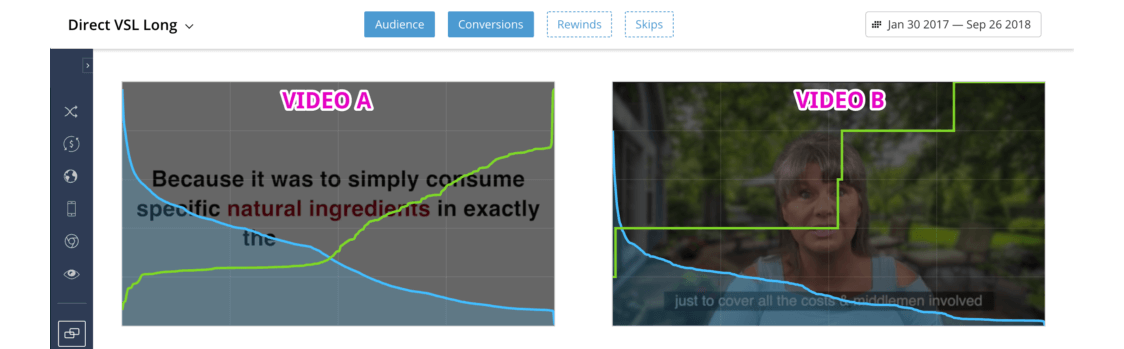
Lesson: higher production value is not the same as higher engagement. Test the opening, and look at where the curves split. Read the case study
Taxaroo: a $1,000 product sold with a long-form VSL
New campaigns did not produce enough purchases to optimize Facebook ads on, so Taxaroo optimized for watch milestones in the VSL instead. Viewers who watched at least 35% of the VSL bought more than any other segment. The approach cut their testing budget by 80% and found winners twice as fast, and their follow-up emails changed with how far each person had watched.
Lesson: how much of a VSL someone watches is a buying signal you can feed back into ads and email. Read the Micro Conversions training
Michael Anderson: getting viewers to the link drop
Michael Anderson's VSL was not getting 40% of its audience to the link drop. The analytics showed heavy mobile traffic and skips on mobile only: going fullscreen on unmute let the phone's own seek bar take over. The fixes: turn that setting off, add an Exit Thumbnail for viewers who pause, rewrite the Smart Autoplay message, and tie the buy button to time in the video instead of time on the page. With the Facebook ads also set to WiFi only, the funnel became profitable.
Lesson: many VSL problems are delivery problems, fixable without editing the video. Read the case study
Triton Growth: VSL audits for agency clients
Triton Growth has managed $80 million in ad spend. They moved all of their clients from Wistia to Vidalytics, and for one client ran a full VSL optimization audit of engagement, drop-off points and high-converting sections. In their words: "The moment we optimized the VSL, our client's sales took off."
Lesson: treat a VSL as something you optimize, section by section, not something you finish. Read the case study
What marketers who run VSLs say, from our Funnels & VSLs page:
"When I switched over, their Smart Autoplay increased my conversions by 30%. This is why I use Vidalytics for all of my Video Sales Letters."
Jon Benson, Billion Dollar Marketer & Inventor of the Video Sales Letter
"The first version of my VSL hosted on Vidalytics did £70,000. I'm relaunching v2 now."
Claire Jarrett
"I found this feature and saw more than a 5X engagement boost with the same video, just a different ad angle (3.6% vs. 17.34%)."
Joel Erway, Founder CEO of The Webinar Agency, on tracking VSL engagement by UTM parameter
VSL script template
Use this outline to draft a VSL script. Write it as spoken words, read it out loud, and keep each section doing one job. Replace the bracketed text with your own.
1. Hook first 30 to 45 seconds
"If you're [who this is for] and you've [tried X / struggled with Y], this video shows you how to [specific result] without [the thing they dread]. Stay to the end, because [the part most people get wrong]."
Match the ad and the page headline. Name the viewer. Promise one result.
2. Problem and root cause
"You've probably tried [common solution 1] and [common solution 2]. Here's why they didn't work: [root cause]. It isn't [their fault]. It's [the outdated method or missing piece]."
Use the words your customers use to describe the problem.
3. Mechanism
"What changed everything was [the mechanism, in plain words]. It works because [one-sentence reason]. Here's what that looks like: [simple example]."
Explain the idea before you name the product.
4. Proof
"[Customer] went from [before] to [after] in [time]. [Second customer] [result]. [Data point or demonstration]."
Real results only. Specific beats impressive.
5. Offer and value stack
"That's why we built [product]. You get [deliverable 1], [deliverable 2] and [bonus]. [The problem or the alternative] costs [amount]. Today it's [price]."
This is where the buy button should appear under the video.
6. Call to action and guarantee
"Click the button below this video to [get started / book your call]. You're covered by [guarantee]. If you do nothing, [the cost of waiting]."
One instruction. Repeat it once before the video ends.
Already have a script? The Vidalytics AI Script Analyzer scores your VSL using $5.7B+ in real performance data. It breaks down the script's structure, scores it against proven persuasion frameworks and suggests rewrites for problems such as a weak hook or an unclear call to action (Experiments, January 2026 update).
How to make a VSL
- Write the script with the template above, then cut anything that does not serve the section it sits in.
- Record it. Text on screen with stock footage and a presenter on camera both work; neither wins by default. In the presenter test above, the plainer version held more viewers. Record so you can test the opening.
- Build the page. A headline that matches the video's first line, the video near the top, no navigation, and a buy button that stays hidden until the offer. A page builder hosts the page; the video lives on a video host and is embedded in it.
- Host the video on a player built to sell, covered in the next section.
- Launch, read the retention graph, and test one change at a time, starting with the hook.
How to host and measure a VSL
Where you host a VSL changes how it converts. General-purpose players are built to play video. A VSL needs a player that keeps the viewer inside the argument and reports what happened. In Golden Tree Nutrition's test, the same video converted 26% better on Vidalytics than on Wistia and 15% better than on Vimeo before any Vidalytics conversion features were turned on. Here is where each part of Vidalytics comes in.
Get the video played
- Smart Autoplay plays with sound when the browser allows it. When it does not, the video plays muted with a message on top, and restarts from the beginning when the viewer clicks, so nobody misses the hook. It is what produced Brent Messer's 49%.
- Rapid Engage Bar moves the progress bar faster at the start and then slows it down, so the video feels shorter. A direct-response golf business doing mid 8 figures increased its conversions by 10% with it.
- Load speed. Adaptive bitrate streaming, per-title encoding and multiple CDNs keep the video starting fast and stop it from buffering (how we approach speed).
Keep viewers in the pitch
- Timed CTAs reveal the buy button from within the video, at the offer, rather than on a timer tied to the page.
- Exit features catch viewers who pause: an Exit Thumbnail, an Exit Play Gate to capture their email, or an Exit CTA with the offer or a calendar.
- Play Gates put the opt-in form on top of the video instead of on a squeeze page before it, which our Play Gates page says loses 80%+ of leads.
- Resume Play lets returning viewers pick up where they left off instead of starting over.
See where the VSL wins and loses
- Analytics gives you a second-by-second audience engagement graph to find drop-off points, conversion tracking that shows how far buyers watched before converting, heatmaps of skips and rewinds, segments (device, traffic source, buyers vs. non-buyers) and Compare View for two videos side by side.
- Benchmarks compare your metrics with 179,000+ videos hosted on Vidalytics, segmented by industry and video type (Analytics).
- Vids AI reads your engagement and conversion data, detects drop-off patterns using aggregated data from $3.5B+ in tracked video revenue, and recommends what to fix. A VSL gets different recommendations than a webinar or a product demo.
- Micro conversions and CRM tagging send watch milestones to your ad platforms and email tool, the way Taxaroo did.
Test changes with Experiments
Experiments runs an A/B test between two videos on the same placement. You pick one goal (conversions, CTA clicks, opt-ins, unmute rate or average % watched), and the Winner Recommender tells you when the result is safe to call, so you can roll the winner out to all traffic. Good first tests for a VSL: the hook, the time the buy button appears, and player settings such as autoplay and the progress bar.
Comparing where to host your VSL?
See how Vidalytics is set up for VSLs on the Funnels & VSLs page. There is a free-forever plan; paid plans are on the pricing page.
Video sales letter FAQ
What does VSL stand for?
VSL stands for video sales letter: a sales video that makes a full pitch, from the hook to the offer and the call to action, usually on a landing page built around the video. It is the video version of the long-form written sales letter.
How long should a video sales letter be?
As long as it takes to make the case for the offer, and no longer. The six-part layout in our VSL funnel guide reaches the call to action at around the 15-minute mark, and the long VSL in our Compare View case study revealed its offer at 16:45. Judge length by retention rather than runtime: the Vidalytics Engagement Bridge training calls 40% of viewers still watching when the call to action appears the gold standard. More on VSL length
What is the difference between a VSL and a webinar?
A VSL is on demand: the visitor lands on the page and the pitch starts. A webinar usually asks people to register and then show up at a set time, and each of those steps loses people before the pitch begins. That is why many marketers turn automated webinars into VSLs. Next-Gen Video Funnel training
What is a VSL funnel?
A VSL funnel sends traffic from an ad or email to a page with the VSL, reveals a buy button, application form or calendar when the video reaches the offer, and ends in a purchase or a booked call. Our guide to VSL funnels
What should a VSL landing page include?
A headline that matches the ad and the video's first line, the video near the top, no navigation links, and a call-to-action button that stays hidden until the video reaches the offer. Anything else on the page is a way out of the pitch.
Can you host a VSL on YouTube or Vimeo?
You can, but general-purpose players show channel links, share buttons and suggested videos that lead viewers away, let viewers scrub ahead to the price, and either stall or play silently when a mobile browser blocks autoplay. In Golden Tree Nutrition's 595,000-session split test, the same VSL converted 26% better on Vidalytics than on Wistia and 15% better than on Vimeo, and YouTube converted below Wistia. Read the 595,000-session split test
What is a good conversion rate for a VSL?
It depends on the traffic, the price and the goal (a purchase or a booked call). As one reference point, Golden Tree Nutrition's split tests on cold search and Google Display Network traffic converted between 0.17% and 0.26%, depending on the player. Warm traffic and lower-priced offers convert higher. Compare against your own baseline, and use Vidalytics Benchmarks to see how your metrics compare with videos in your industry.
Can AI write a video sales letter?
AI can help with a first draft, but what matters is how real viewers respond to the script. The Vidalytics AI Script Analyzer works on a script you already have: it scores your VSL using $5.7B+ in real performance data, flags structural problems such as a weak hook or an unclear call to action, and suggests rewrites. See the AI Suite
Ready to Increase Your Conversions?