How to Build a High-Converting VSL Funnel and Stop Video Drop-Offs
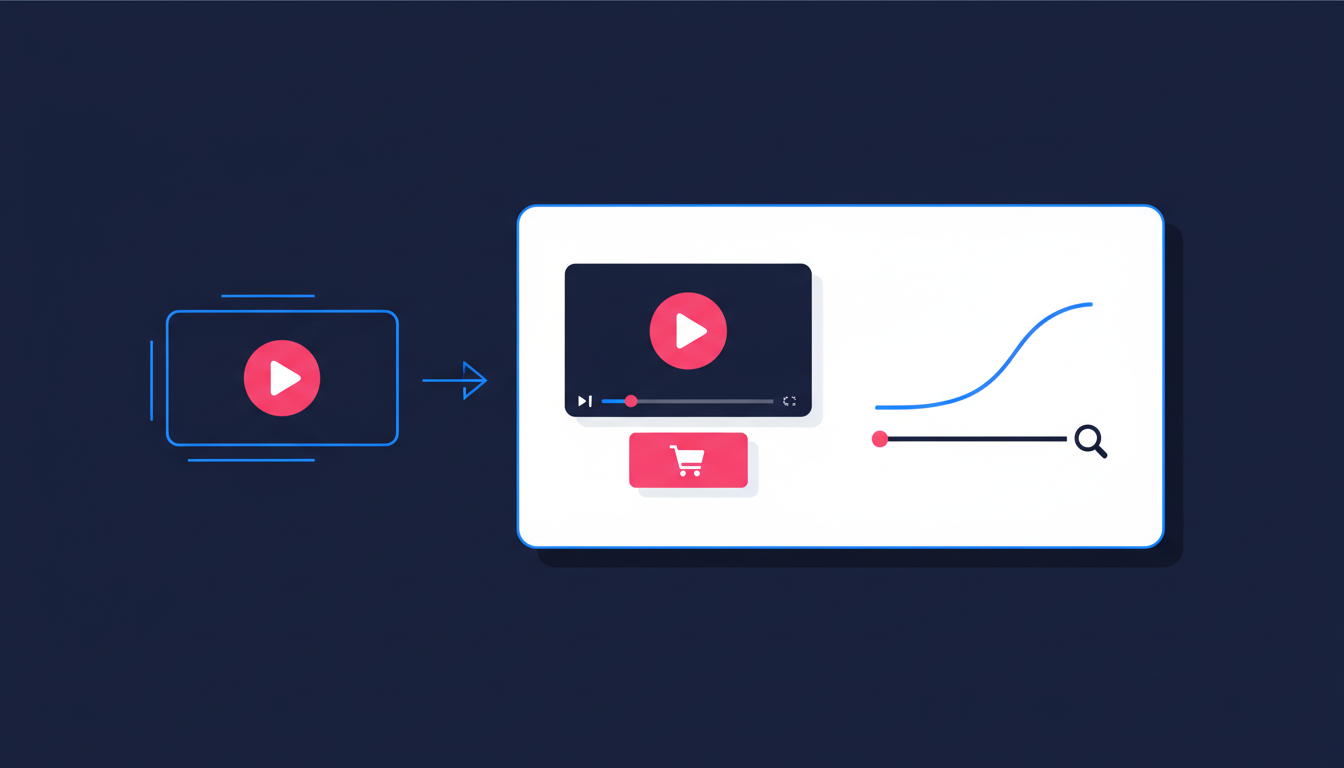
A VSL funnel (video sales letter funnel) is a digital sales sequence that uses a structured video presentation to convert traffic into buyers or qualified sales appointments. It directs visitors from an advertisement to a landing page where a video delivers the sales pitch before displaying the purchase or booking call to action.
Most marketing teams focus exclusively on rewriting scripts when conversions drop, ignoring player friction like buffering and mobile autoplay blocks. You can see how player-level delivery and conversion tracking protect your presentation in the Vidalytics demo.
What Is a VSL Funnel and How Does It Work?
A video sales letter funnel replaces traditional, text-heavy sales pages with an audio-visual presentation. In direct-response marketing, long-form sales copy used to carry the entire persuasive burden. Today, according to ClickFunnels video funnel documentation, video marketing accounts for roughly 82% of all global internet traffic. Buyers consistently prefer watching and listening over scrolling through thousands of words of body copy.
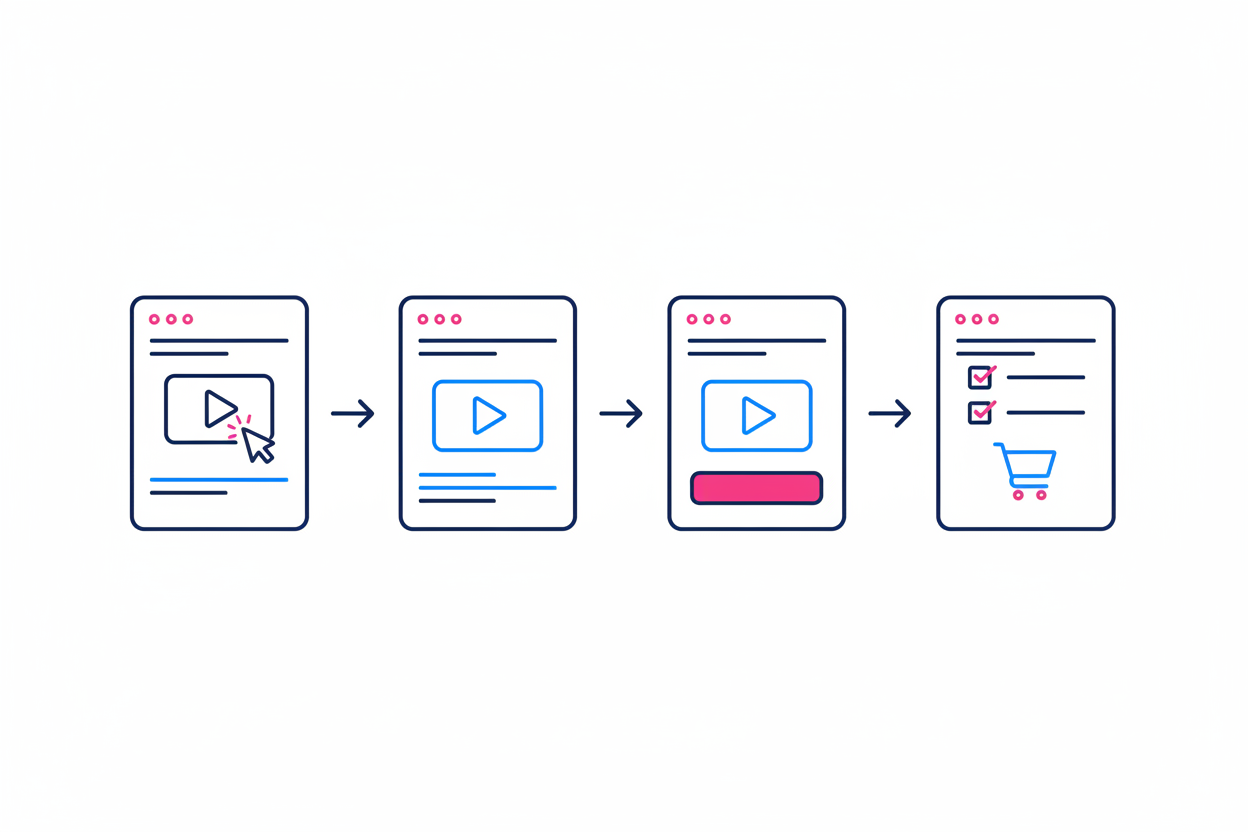
A typical conversion sequence operates across four distinct stages:
- The Traffic Source: Cold or warm prospects click through from paid social ads, search campaigns, pre-roll video, or partner email broadcasts.
- The VSL Landing Page: A clean page displaying an engaging headline and a video player, deliberately free from top navigation bars or exit distractions.
- The Offer Reveal: At the exact second the presenter introduces the solution and price, an order button, application form, or calendar embed appears dynamically beneath the player.
- The Conversion Step: The prospect completes the transaction or schedules an onboarding call, followed by upsell steps or a confirmation sequence.
For businesses running dedicated VSL funnels, this architecture functions across front-end info-products, high-ticket coaching programs, software trials, and physical direct-to-consumer goods. Because visitors cannot easily skim ahead to judge the price tag out of context, they absorb the problem agitation, the educational framing, and the proprietary solution mechanism before making a purchasing decision.
The Direct-Response Structure of High-Converting VSL Funnels
A winning video sales letter is an engineered persuasive argument. If you jump between ideas too quickly or present your commercial offer prematurely, viewers leave. Direct-response copywriters rely on a standardized narrative arc designed to hold audience retention until the call to action appears.
1. The Hook (0:00 to 0:45)
The opening 45 seconds determine whether your media budget generates returns or disappears. The hook must state your core promise, identify the ideal viewer, and disrupt conventional assumptions. If your hook fails to establish immediate relevance, viewers abandon the page before your core thesis begins.
2. Problem Agitation and the Root Cause (0:45 to 3:00)
Describe the prospect’s day-to-day frustration with granular accuracy. Validate why their previous attempts to solve the problem failed. Show that their lack of success is not due to personal failure or missing willpower, but rather an outdated method, an incomplete framework, or an external systemic obstacle.
3. The Discovery and the Mechanism (3:00 to 7:00)
Introduce the core mechanism behind your solution. This is not your specific product name yet. It is the underlying scientific, operational, or strategic breakthrough that makes solving the problem possible. Explaining this mechanism gives prospects logical justification to believe that this time will be different.
4. Proof and Case Studies (7:00 to 11:00)
Stack tangible proof before introducing commercial terms. Present verified student or customer data, before-and-after timelines, and concrete benchmarks. In a rental property mentorship campaign documented by AdClass Case Studies, replacing an underperforming 20-minute presentation with a concise 5 to 8 minute case-study video reduced qualified cost-per-call from $120-$130 down to approximately $90, while lifting return on ad spend (ROAS) from 0.5X to 2.9X.
5. The Offer Reveal and Value Stack (11:00 to 15:00)
Introduce your product as the vehicle that implements the proven mechanism. Detail the deliverables, software access, bonuses, and operational support. Contrast your asking price against the financial or emotional cost of leaving the underlying problem unsolved.
6. The Call to Action and Risk Reversal (15:00 to End)
Give one unambiguous instruction: click the button below to complete checkout or schedule an appointment. State the terms of your guarantee, address common onboarding hesitations, and remind the viewer of the cost of inaction.
The Technical Delivery Gap: Why Standard Players Break VSL Funnels
Marketers frequently spend weeks writing a script and allocating substantial capital to media buying, only to embed their video using generic hosting platforms or YouTube unlisted links. This creates immediate revenue leaks.
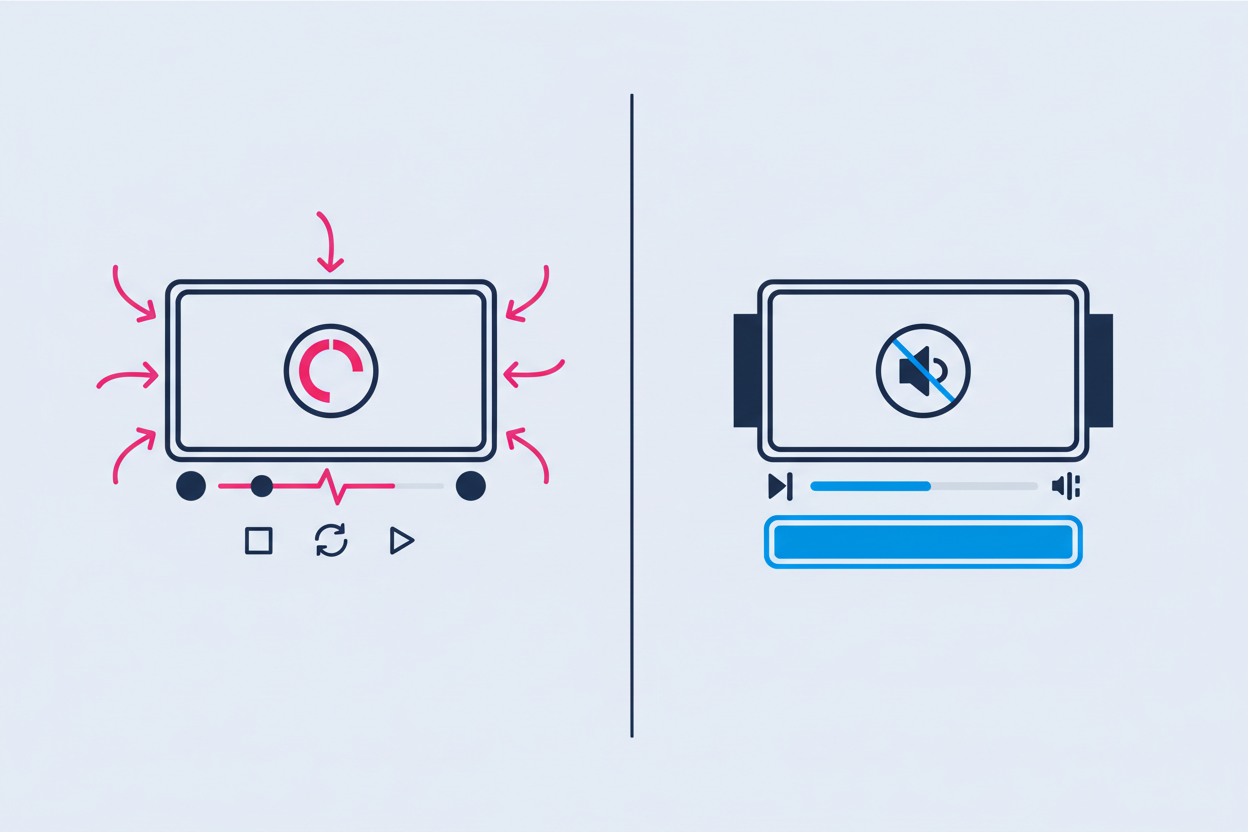
Standard video players are built to host and stream media; Vidalytics is built to turn video views into sales.
When a standard video player delivers a sales presentation, several technical friction points degrade funnel performance:
- Mobile Autoplay Restrictions: Mobile operating systems (such as iOS Safari and Android Chrome) block unmuted autoplay. When a basic player hits these restrictions, it either pauses entirely or plays silently while the viewer misses the critical opening hook.
- Uncontrolled Player Leakage: Standard embeds from YouTube or Vimeo display channel icons, share links, and suggested videos on pause. A prospect who clicks an external icon leaves your landing page and enters a social algorithm loop.
- Premature Purchase Exposure: If your order button sits beneath the video upon initial page load, visitors scroll down, review the price without understanding your value proposition, and leave immediately. You need synchronized, in-player calls to action that remain hidden until the offer timestamp.
- Progress Bar Scrubbing: Standard scrub bars invite viewers to skip ahead to find the price or jump straight to the conclusion, skipping your narrative build-up and proof.
- Bandwidth and Buffering Drops: Default file streaming attempts to deliver heavy video files over variable cellular networks. If the playback pauses to buffer during your hook, the visitor bounces.
| Feature Dimension | Standard Player (YouTube / Vimeo) | Conversion Player (Vidalytics) | Source Verification |
|---|---|---|---|
| Mobile Autoplay Handling | Freezes or plays muted without replaying intro | Smart Autoplay mutes, prompts unmute, and restarts automatically | Brent Messer Split Test |
| Offer Synchronization | Static buttons visible on initial page load | Timed button reveals tied to exact player timestamps | Calls to action | | Progress Bar Controls | Unrestricted scrubbing allows skipping the pitch | The Rapid Engage Bar preserves narrative pacing | Rapid Engage Bar | | Conversion Attribution | Basic view counts and estimated completion | Drop-off heatmaps matched directly to customer actions | Conversion Analytics |
Solving mobile delivery is critical for profitability. In a split test run by Brent Messer, documented in our Smart Autoplay case study, enabling mobile autoplay with a restart-on-unmute setting produced a 49% higher conversion rate compared to the control version on cold affiliate traffic.
Analyzing Retention Drop-Off Curves in VSL Funnels
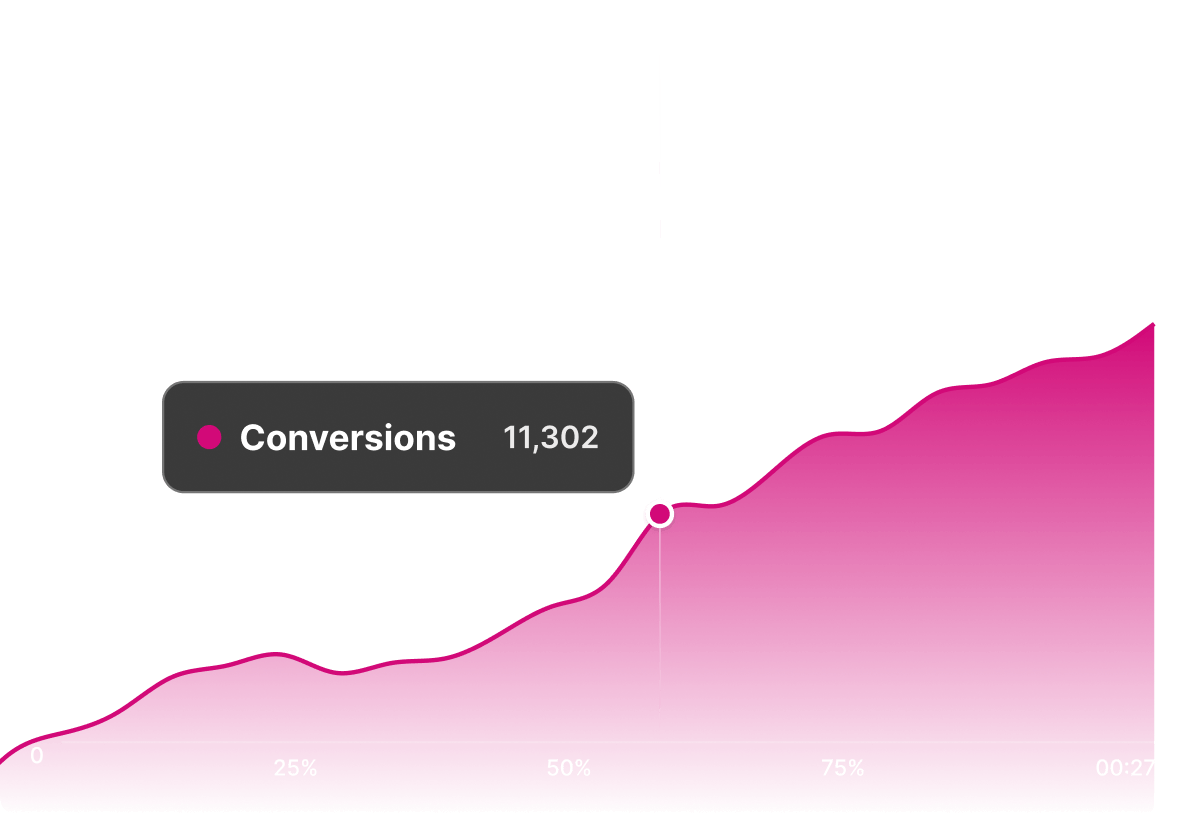
To diagnose an underperforming funnel, you must evaluate audience retention drop-off curves rather than surface-level metrics like aggregate play counts. Using video analytics and conversion heatmaps reveals exactly where prospects abandon the presentation.
The Opening Drop (Seconds 0 to 30)
A steep drop right after playback begins signals either slow player loading or a mismatch between the landing page headline and the video opening sentence. If the player buffers on a mobile cellular connection, visitors exit before the first frame appears. If delivery is fast but viewers drop immediately, test your visual presentation.
In our published split test compare case study, testing two versions with identical opening copy revealed that introducing an on-camera presenter dropped audience engagement to 49% by the 0:35 mark, compared to 68% retention on the original text-and-stock-footage version. Without player-level drop-off heatmaps, an operator might assume the script or the offer failed.
The Conceptual Transition (Minutes 3 to 6)
Viewers who make it past the hook often leave when the presentation shifts from emotional problem agitation into structural education. If this section feels academic or slow, retention drops steadily.
The Offer Reveal
A noticeable drop often occurs when the presenter transitions from free educational content into the commercial pitch. In our video conversion optimization case study, executive coach Michael Anderson found that his original video produced a higher click-through rate (CTR) than a revised version because the earlier version dropped the purchase link sooner. However, earlier link drops trade lead qualification for raw clicks. Reviewing full funnel data ensures you do not mistake higher click volume for ultimate sales revenue.
Anderson also discovered that enabling mobile fullscreen allowed the smartphone operating system to override player controls, introducing a native scrub bar that let visitors skip forward. Disabling mobile fullscreen helps ensure the audience gets the whole message before deciding whether to purchase.
In a multi-network split test across 595,000 sessions analyzing four platforms, documented in our four-player split test case study, Vidalytics outconverted Wistia by 26% (0.24% conversion rate vs 0.19%) and Vimeo by 15% (0.26% conversion rate vs 0.23%). This performance spread occurred even before Vidalytics conversion features were enabled, indicating that fast streaming delivery alone directly impacts front-end sales.
How to Split Test and Optimize a VSL Funnel
Optimizing a video funnel requires testing distinct variables systematically. Changing your script, headline, and offer simultaneously makes it impossible to isolate which element drove performance shifts. Deploy native video split testing using Vidalytics Experiments to evaluate one variable at a time.
1. Opening Hooks and Visual Delivery
Test two radically different opening angles during the first 30 to 45 seconds while keeping the remainder of the video identical. You can test a problem-agitation lead against a contrarian-mechanism lead, or evaluate text-on-screen against live presenter footage. Tracking second-by-second retention curves reveals which hook holds traffic through the first two minutes.
2. Video Duration and Framing
Marketers often assume longer presentations inherently sell better. However, as demonstrated in the AdClass case study, condensing a 20-minute video into an 8-minute case study dramatically lowered acquisition costs. Run an experiment testing an in-depth educational presentation against an abbreviated, proof-heavy breakdown to identify the ideal length for your specific market.
3. Timed CTA Placement
The timestamp when your order button or calendar form appears influences both conversion rate and sales qualification. Dropping the button earlier exposes more visitors to the checkout link, which may lift raw click volume. Dropping the button later ensures that only thoroughly educated prospects click through, which can result in higher order values or better sales call close rates. Split test button reveal timing by experimenting with dropping the button at different times.
4. Player-Level Settings
Test functional playback settings that affect user experience without requiring you to re-record your video. Compare autoplay with sound muted against click-to-play, evaluate the Rapid Engage Bar against hidden player controls, and test custom pause thumbnails against static preview frames. These player adjustments often fix conversion leaks that appear to be copywriting problems.
Funnel Software Costs and Technical Infrastructure
Operating high-converting funnels requires balancing software subscriptions against customer acquisition costs (CAC). Builders require two primary technical tools: a landing page builder to host the surrounding page structure and a video platform to stream the presentation asset.
For landing page builders, tools like ClickFunnels provide standardized sales templates. According to ClickFunnels pricing documentation, their Launch tier costs $97 per month (or $970 billed annually), while their Scale tier costs $197 per month ($1,970 annually) for up to 75,000 contacts and 5 workspaces.
Some operators attempt to reduce software overhead by hosting video files directly on cloud infrastructure like Amazon Web Services (AWS) S3. However, as outlined in our AWS video hosting analysis, AWS does not provide an HTML5 video player, adaptive bitrate streaming, mobile autoplay logic, or conversion heatmaps. Building custom video infrastructure requires extensive engineering time and ongoing maintenance that far exceeds specialized hosting software costs.
At scale, media efficiency depends on tracking granular viewing behavior. For instance, Triton Growth managed over $80 million in ad spend and switched their client accounts to Vidalytics specifically to access micro-conversion tracking inside ad platforms and tag viewers based on exact drop-off points.
Connect Your Video Delivery to Revenue
Fixing video leaks in your funnel does not require reshooting your creative from scratch. By adjusting player delivery settings, implementing timed call-to-action buttons, and reviewing audience drop-off heatmaps, you can optimize your conversion path with your existing video asset. Check our pricing plans to review Starter ($19/mo billed annually), Pro ($63/mo billed annually), Premium ($119/mo billed annually), or our free-forever plan, or watch the recorded demo to see the conversion features in action.
FAQ
How long should a VSL video be?
An effective VSL duration depends on your price point, offer complexity, and prospect traffic temperature. According to analysis from Radical Marketing, high-ticket coaching funnels typically perform best between 5 to 20 minutes to address core objections without causing audience fatigue.
What is the difference between a VSL and a webinar?
A VSL is an on-demand video presentation hosted directly on an open landing page without scheduling delays, whereas a webinar typically requires users to register for a specific scheduled presentation time. VSL funnels prioritize immediate, low-friction consumption for cold traffic.
What is a good conversion rate for a VSL funnel?
Conversion rates vary significantly based on traffic source, product price, and whether the conversion goal is a checkout purchase or a qualified consultation call. In Golden Tree Nutrition’s split tests across over 595,000 sessions on cold search and Google Display Network traffic, documented in our four-player split test case study, conversion rates across different players ranged from 0.17% to 0.26%. Warm email traffic or lower-priced impulse offers will naturally convert at higher rates, while high-ticket offers focus on booked call volume.
How do you structure a VSL script?
A high-converting VSL script follows a systematic direct-response persuasion architecture: a captivating hook (0 to 45 seconds), problem agitation, introduction of the unique mechanism, case-study social proof, the product offer stack, and an explicit call to action with a guarantee. Each section builds logical necessity for the next step, ensuring the viewer remains engaged until the checkout button appears.
Sources
- ClickFunnels Video Funnel Guide: https://www.clickfunnels.com/blog/how-to-create-a-video-sales-funnel/
- ClickFunnels Pricing: https://support.myclickfunnels.com/docs/clickfunnels-pricing/
- AdClass Case Studies: https://www.adclass.com/case-studies/the-playbook-that-took-a-rental-property-mentorship-funnel-to-180-sales-and-92-qualified-leads-in-6-months
- Radical Marketing: https://www.radical-marketing.com/what-is-a-vsl-funnel-for-coaches/
Ready to Increase Your Conversions?